Interviul Insider, AI
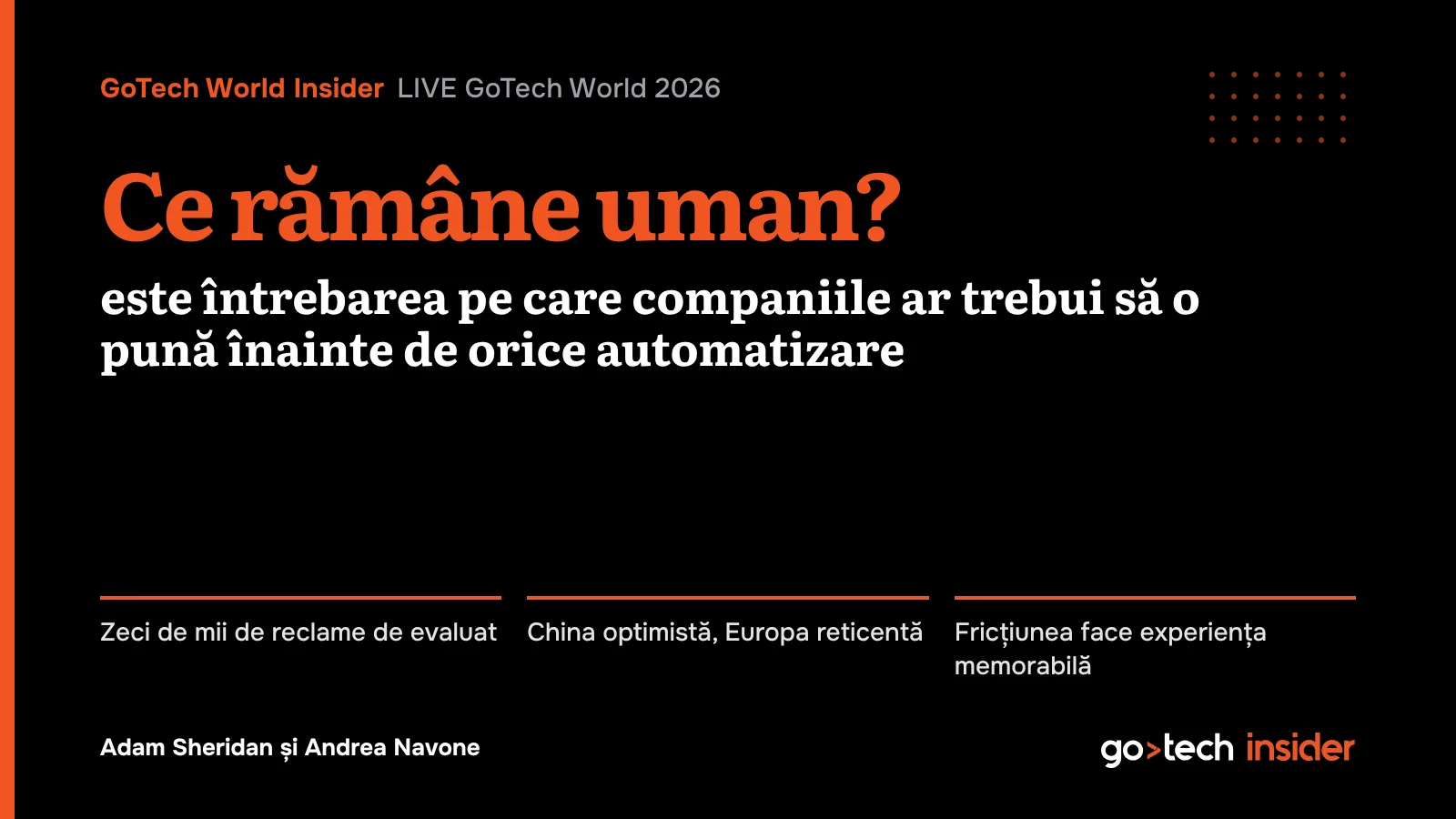
Adam Sheridan (Ipsos) and Andrea Navone: the right question is not what we can automate with AI, but what must remain human
At GoTech World 2026, the Ipsos advertising effectiveness specialist and the Italian designer discussed AI as a creative partner, trust in machines and why design should bring back a little friction.
Pe scurt
- Sheridan: advertisers now produce tens or hundreds of thousands of assets, and evaluating them can only be scaled with AI models
- Navone: designers are moving from designing interfaces to designing the relationship between people and machines
- Ipsos data shows enthusiasm for AI in China and reluctance in Europe
- Their recommendations: experiment and give people time to do so, while retaining human control in automated experiences
Adam Sheridan, Global Service Director for Creative Effectiveness at Ipsos, and Italian designer Andrea Navone, former Chief Experience Officer at Dentsu Creative Italia, were guests of the GoTech World Insider series on the second day of GoTech World 2026. Both also gave presentations on stage.
Sheridan, from London, works on evaluating ads using data on people's responses and predictive models to identify the assets with the greatest sales potential. The problem, he explained, is volume: an advertiser no longer produces a few hundred assets, but tens or hundreds of thousands, because of social platforms. The only way to evaluate them at this scale is with AI prediction models. The time is approaching when evaluation models will instruct models that generate video to edit ads. That could lead to a dystopian future in which one model feeds on another, or to one in which people oversee the process and use it to become more efficient.
Navone, from Turin, said designers now have a new responsibility: technology is becoming invisible, and many AI decisions are made in a black box. The paradigm must shift from designing interfaces to designing the relationship between people and machines, with trust at stake: how to build a world in which people can entrust machines with their data and money. Navone compared the current moment to the Industrial Revolution, when modern design emerged as a link between people and a world transformed by technology.
Sheridan cited Ipsos data from global surveys: in China, the public is highly optimistic about AI, while hesitation and distrust dominate in Europe. On ethics, Navone said the question he hears at every company, what can we automate today, is the wrong one. The right question is what must we keep human. Sheridan added that AI needs us because models are trained on human data, and that at Ipsos, the creation of a “digital twin,” a digital representation of a respondent, goes through legal, contractual and data storage checks.
On experience, Navone observed that after 20 years of removing all friction from digital design, every experience looks the same. Brands need subjectivity and moments of friction, because difficulty stimulates cognitive engagement, and attention makes the experience memorable. For new formats such as short videos, which many brands have yet to master, Sheridan recommends investing in quality data on people's responses, which can then be used to build models.
Their final advice: Sheridan asked executives to make room for experimentation and include it in people's objectives, rather than adding it to an already full schedule. Navone called for experiences to remain human even when they are fully automated, citing autonomous cars in the US, where screens, physical stop buttons and pause options have been introduced.
De ce contează
For marketing and product teams in Romania, the discussion offers a simple test for automation projects: what remains a human decision and what can be delegated to the model.
Unghiul Insider
In an industry where AI can generate, evaluate and optimize content, the risk is that efficiency becomes the sole criterion for decisions. But memorable ads and experiences are not built through optimization alone: they need creativity, identity and human intervention. The challenge for companies is to use AI without losing the very things that set them apart.
Surse
- Interviu video GoTech World Insider, YouTube, noiembrie 2026
- Playlist GoTech World Insider 2026, noiembrie 2026