Analiza Insider, Smart Home
Since September, every new connected device sold in the EU must give you direct access to your data. What changes for the smart home
The Data Act's "access by design" obligation applies to connected products placed on the market after September 12, 2026. Makers have to build it into the product, not answer requests.
Pe scurt
- The obligation applies to connected products and related services placed on the market after September 12, 2026
- Data generated by use must be directly accessible by default, where technically feasible
- The Data Act has applied generally since September 12, 2025, and the design rule had a one-year delay
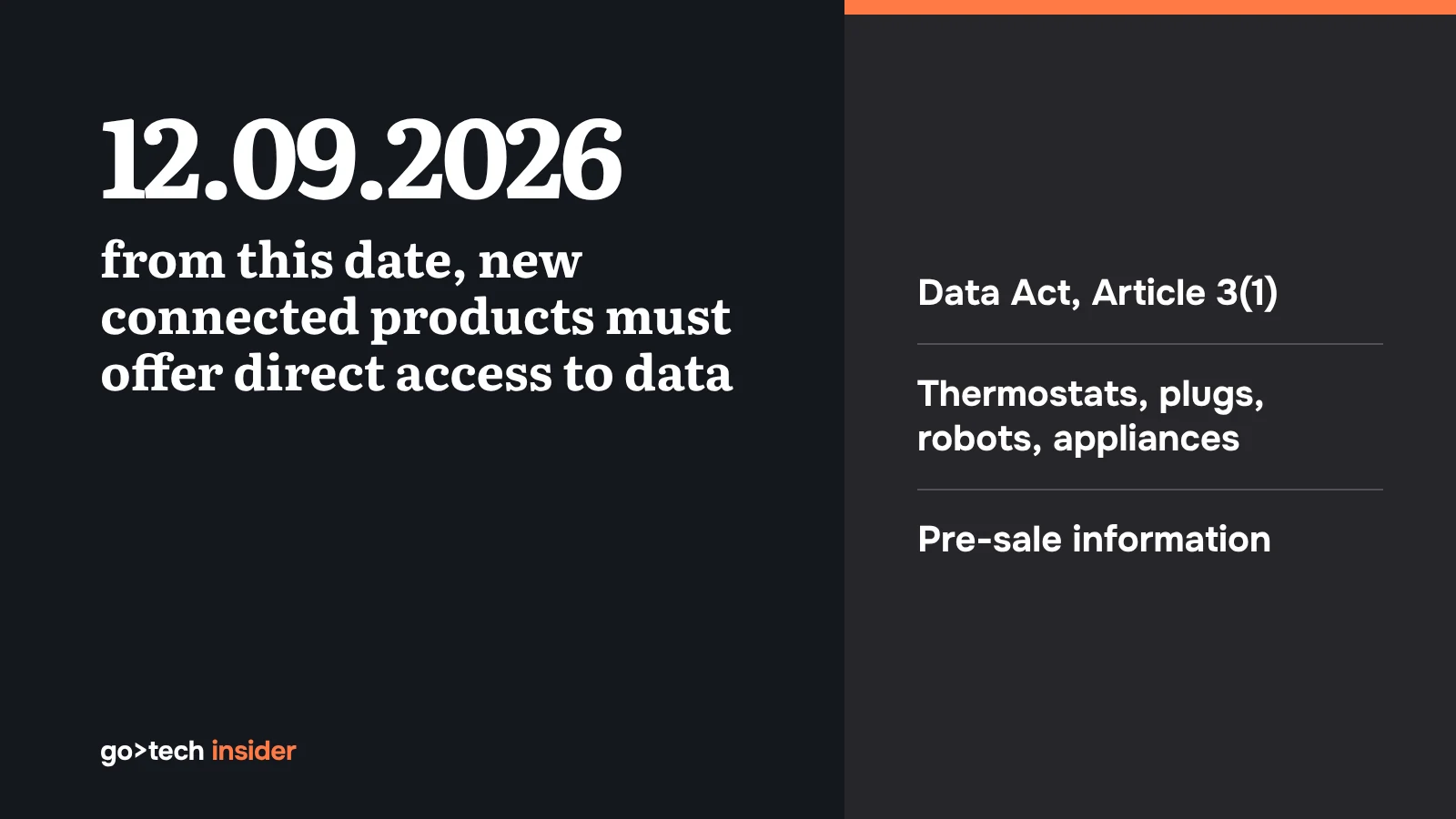
The EU Data Act has applied since September 12, 2025. On September 12, 2026, an obligation delayed by one year came into force: connected products and related services placed on the market after that date must be designed so that the data generated by their use is accessible to the user directly and by default, where relevant and technically feasible.
Until now, users could ask the manufacturer for their data. From now on, for new products, access must exist by design, without costs or procedures that discourage it. The rule is called "access by design" and is set out in Article 3(1) of the regulation.
In the smart home, the rule touches almost everything: thermostats, smart meters and plugs, robot vacuums, connected appliances, security systems. A "connected product", in the regulation's sense, is any product that collects data about its use or environment and can transmit it. Makers must tell buyers, before the sale, what data the product generates, in what format and how they can access it.
Lawyers who have analysed the text stress that the obligation applies to new products, not to those already sold, and that makers have some room to interpret which data is "relevant". Member states designate their enforcement authorities and penalties.
De ce contează
For makers and importers of connected devices in Romania, the Data Act means product work, not just legal work: export interfaces, documentation and pre-sale information. For integrators and energy service companies, data becomes easier to use, with the user's consent.
Unghiul Insider
The Data Act is the most underrated smart home change of 2026. Combined with Matter and the push for local control, the rule weakens the model in which the maker keeps the home's data to sell you subscriptions. The winners will be companies that build services on top of other people's data.