De pe scenă, AI
Capgemini's Elisa Sai: 70 pilots and only one in production is not a result, it is a red flag
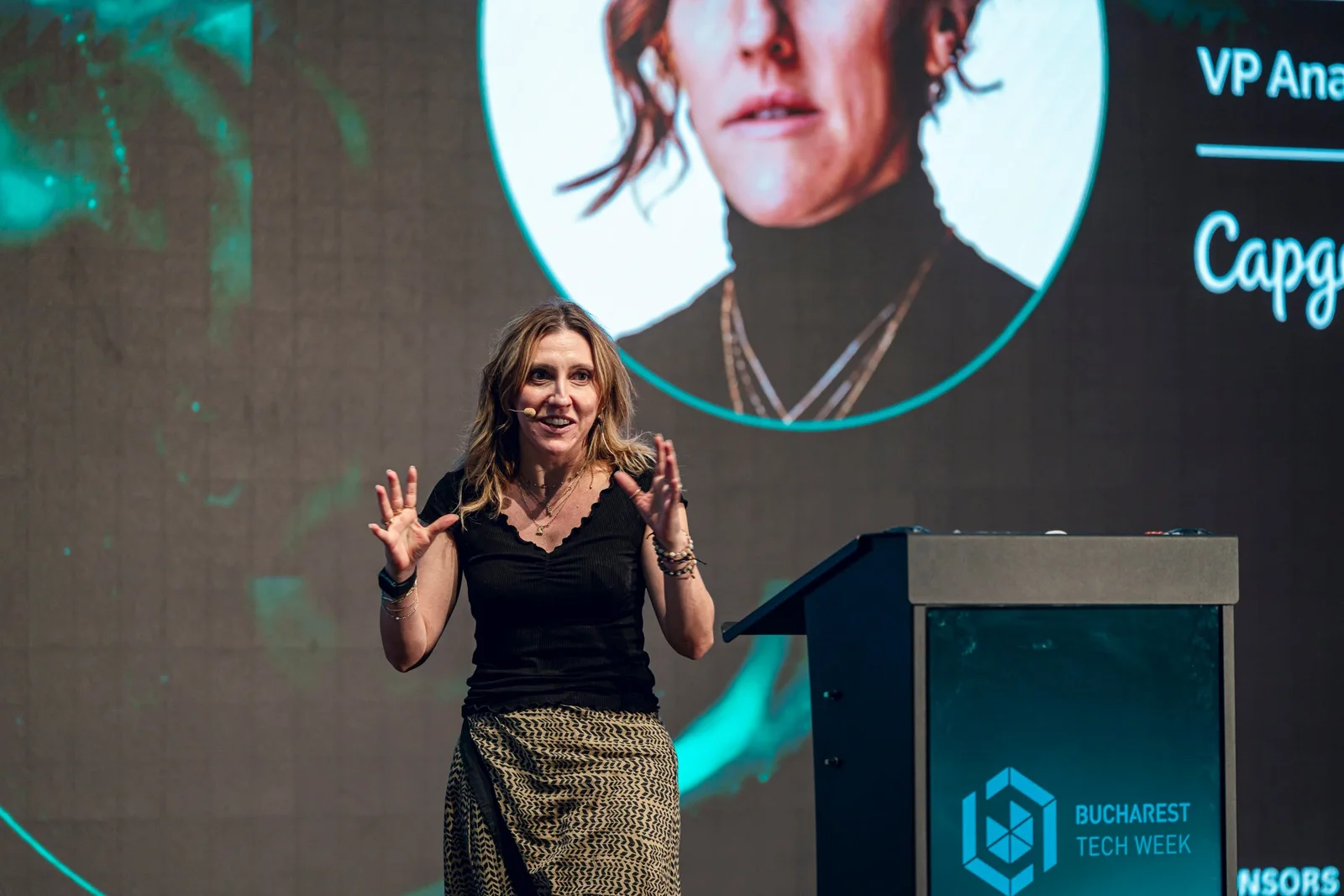
Elisa Sai, VP Analytics & AI at Capgemini Invent, spoke at Bucharest Tech Week 2026, at Future Summit: AI. She explained why enterprise AI value depends on a few leadership decisions, not on the model or the number of projects.
Pe scurt
- AI value is measured across the whole workflow, not in hours saved
- Work has to be redesigned for mixed teams of people and agents
- Controls have to be written into the workflow, not kept in a PDF
Elisa Sai, VP Analytics & AI at Capgemini Invent, spoke at Bucharest Tech Week 2026, at Future Summit: AI, about the leadership agenda for AI value at scale. Her thesis: almost every company already uses AI, but few manage to turn it into results across the whole business. The difference is not more projects, but fewer, better decisions.
The first decision concerns how value is measured. Many companies report local gains: one team writes code faster, another finds information more easily. Sai described a scene she says she sees often in boardrooms: a head of department presents a 30 or 40% productivity gain, everyone is delighted, then someone senior asks what it means for the business. And the room goes silent. Hours saved are worth nothing if they are spent cleaning your inbox, she said. What matters is how much of a messy workflow an agent can handle end to end, how quickly the company gets to an action rather than just an insight, and how reliably the system works within its boundaries.
This is also where the courage to say no comes in. A portfolio of 70 pilots with only one in production is not a good result, Sai said, but waste and a red flag. Money should go to whatever blocks scale: data quality, data foundations and the semantic layer agents need. Cost discipline matters just as much. She cited Uber, which, according to the US press, used up its 2026 budget for AI coding tools in four months. Using a frontier model to extract data from an invoice is not sophistication, it is waste. The level of intelligence has to match the value of the task.
The second decision concerns how work gets done. Sai described a supply chain case: one agent picks up risk signals, an analyst agent assesses the impact, a planning agent proposes options and an orchestration agent launches the interventions. The person no longer hunts for data but validates and approves, and remains accountable. This is not automation layered on an old process, but a process designed from scratch.
The third decision concerns control. When AI only answers questions, a mistake is easy to ignore. When it triggers actions in a workflow, a mistake has consequences for compliance, cost or even citizens, in the public sector. That is why rules can no longer sit in a document or a monthly committee. They have to be written directly into the workflow, with checkpoints where a human steps in.
Trust is the central problem here. A Capgemini Research Institute study of 1,500 executives in 14 countries found that trust in fully autonomous AI agents fell from 43% to 27% in a year. Asked why by an audience member, Sai said hallucinations are not the main cause, but the fact that leaders see costs rising without seeing results across the company. The biggest obstacle in projects that fail, she added, is adoption: behaviour that is slow to change, not a lack of training.
De ce contează
Romanian companies are exactly in the phase Sai describes: many pilots, few projects in production, rising budgets. Her framework gives managers three concrete questions for their next AI budget meeting: what we measure, which process we redesign and how we control what the agent does.
Unghiul Insider
The most useful idea in the talk is also the most uncomfortable: sometimes leadership means stopping projects. In a market where every department wants its own AI pilot, saying no to 60 of them to take 10 into production takes more courage than launching another one. And her closing comparison holds: many companies buy a Ferrari when a Punto with a good engine, meaning clean data, would do.