Insider Daily, Global
US approves the first data center system in space: SpaceX may launch up to one million Starmind satellites
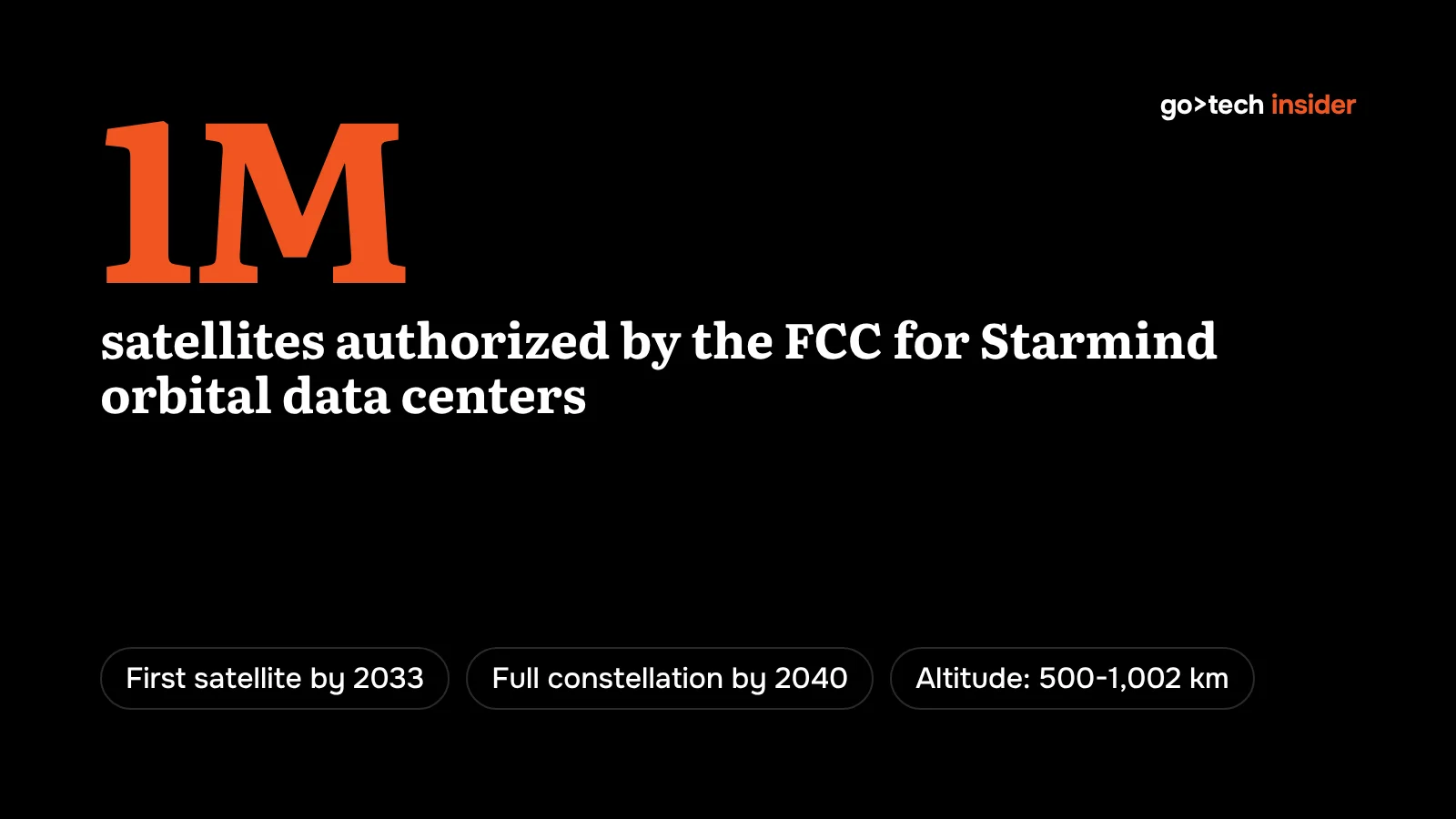
The Federal Communications Commission granted a conditional authorization on Wednesday. The first satellite must be operating by 2033 and the full constellation by 2040.
Pe scurt
- The FCC authorizes up to one million satellites for Starmind orbital data centers
- The first satellite must be operating by 2033, the full constellation by 2040
- Amazon, Viasat and US astronomers objected, but their objections were rejected
The US Federal Communications Commission (FCC) on Wednesday, 25 November, authorized SpaceX to launch and operate up to one million satellites for Starmind, its network of data centers in orbit. The agency describes it as the first authorization in US history for a constellation of data centers in space. The satellites will fly at altitudes between 500 and 1,002 kilometers and communicate with each other over optical links.
The approval comes with conditions. SpaceX must maintain backup communications, report regularly and submit a detailed orbital debris mitigation plan. The first satellite must be operating no later than 2033 and the full constellation by 2040. The FCC has not yet approved the company's debris plan for satellites operating above 600 kilometers.
The application, filed at the end of January, was opposed by Amazon, Viasat and the American Astronomical Society, which is concerned about the effect on the night sky. The FCC rejected the objections and said many questions about the feasibility of orbital data centers fall outside its mandate. FCC Chairman Brendan Carr spoke of a new frontier for computing infrastructure.
In August SpaceX announced a partnership with Nvidia for the compute payload of its first satellite, Starmind AI1, which will use Rubin GPUs and Vera CPUs. Other projects are awaiting FCC decisions: Blue Origin has applied for 51,600 satellites and Starcloud for 88,000. SpaceX shares closed the day up 1.3%.
De ce contează
Data centers are increasingly constrained by energy and the power grid. If the orbital model works, part of AI computing could move to where solar power is always available, and the cloud market would gain an entirely new competitor.
Unghiul Insider
The authorization does not mean data centers in space are close. Cooling, orbital debris and launch costs are still unsolved. For Europe the question is different: if computing infrastructure moves into orbit, who regulates it and where does the data sit.
Surse
- FCC order DA 26-1273, via GeekWire, 25 Nov 2026
- TechCrunch, 25 Nov 2026
- CNBC, 25 Nov 2026