Interviul Insider, AI
Gijs den Butter, SenseGlove: the gloves that let you touch the virtual world are now teaching robots how hard to grip a cup
The CEO of Dutch company SenseGlove explained at GoTech World 2026 how the same haptic technology is used to train aircraft mechanics and nurses in VR and to train humanoid robots.
Pe scurt
- SenseGlove has spent 10 years making gloves that reproduce the force, texture and shape of objects in virtual environments
- The first use is VR training, for example aircraft maintenance at Japanese airlines or training nursing students in Poland
- The second is teleoperation and training of humanoid robots, for which vision alone is not enough
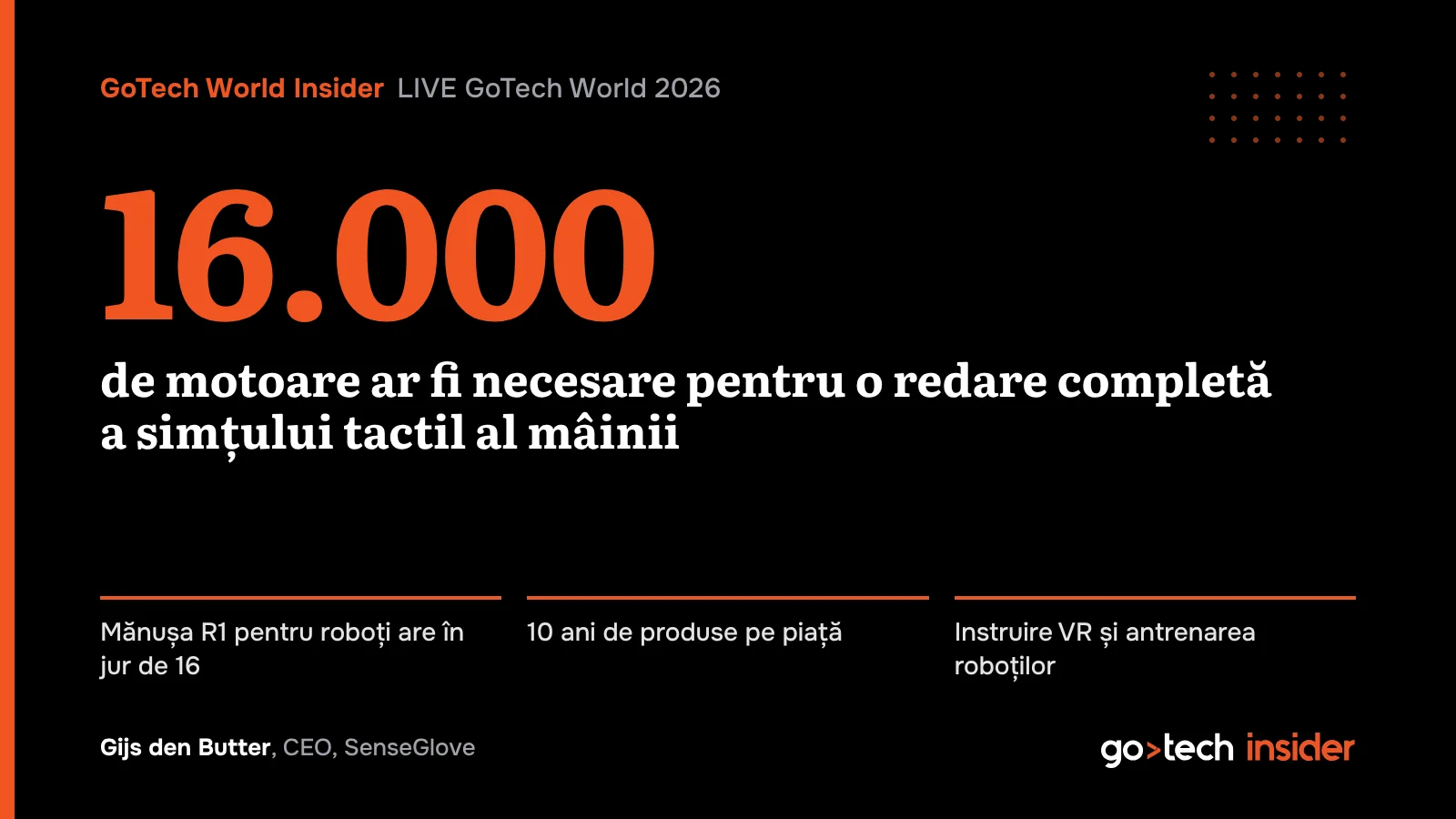
- Fully reproducing the sense of touch would require around 16,000 motors; the R1 glove for robots has around 16
Gijs den Butter, CEO of SenseGlove, was a guest in the GoTech World Insider series at GoTech World 2026, where he also spoke on the main stage. For ten years, the Dutch company has been building gloves that let you feel the digital environment: the force you apply to an object, its size and density, its surface texture or the boundary of a wall that does not physically exist.
The first area of use is virtual reality training, where equipment is expensive and many people need to learn physical tasks. Den Butter cited aircraft maintenance, where keeping a plane on the ground for training is costly, and mentioned a major project with Japanese airlines. In healthcare, SenseGlove has an implementation in Poland, where students training to become nurses learn to prepare an operating room in a safe virtual environment, without having to use real medical equipment.
The second area is robotics. Humanoid robots can dance, but a simple task such as picking up a cup without crushing or dropping it is very difficult for them. Through teleoperation, a person controls the robot remotely and receives haptic feedback, allowing them to feel the forces experienced by the robot. Den Butter also described a complementary method: millions of workers around the world wear head-mounted cameras that record what they do, so robots can learn from human behavior, after which the robots practice in simulated environments before entering the real world. In this area, SenseGlove works with major AI labs and humanoid robot manufacturers.
Den Butter, who trained as a designer and engineer at Universitatea Tehnică din Delft, explained the constant trade-off between technology and ease of use. The Nova glove, designed for training, looks user-friendly because the user should not have to think about the technology. The R1 glove, for robots, looks like “a spider hand,” but delivers the highest quality. Fully reproducing the hand would require approximately 16,000 motors. Currently, the R1 glove has around 16 actuators. Den Butter does not consider it realistic that a glove with that level of fidelity will emerge in the next decade.
In the short term, the company is testing new actuation technologies, such as shape-memory alloys and piezoelectric elements, with the goal of shrinking actuators from 3 centimeters to 3 millimeters. When it comes to haptic interaction, Den Butter believes it should be as natural and intuitive as possible, without drawing attention to itself. He cited the automotive industry, where manufacturers that replaced physical buttons with touch surfaces are beginning to return to physical controls because the touch controls did not prove intuitive enough for users.
De ce contează
Training humanoid robots has become one of the best-funded areas of AI, and the sense of touch is one of their main limitations. The interview shows where the technology stands and what is still missing.
Unghiul Insider
Humanoid robots need more than intelligence and vision. They also need the ability to feel and interpret the physical world. This could be one of the biggest challenges in the next stage of AI development: turning actions that humans perform instinctively into movements that robots can reproduce with precision and control.
Surse
- Interviu video GoTech World Insider, YouTube, noiembrie 2026
- Playlist GoTech World Insider 2026, noiembrie 2026